Library · Why Armenia Should Be Free
Turkish and Russian Proposals to the Armenians in 1914
In the beginning of this world conflagration, in 1914, both the Russian and the Turkish governments officially appealed to various Armenian national organizations with many promises in order to secure the active participation of the Armenians in the military operations against each other, the principal stage of which would be Armenia itself. Both Turkey and Russia were very anxious to win the co-operation of the Armenians, because, judging from their past experience, they were convinced that without such co-operation they would not be able to accomplish the much desired military successes on the Armenian plateau.
With such aims in view, Russia, through Count Varantzoff Dashkoff, informed the Armenian National Council (then in existence at Tiflis) that if the Armenians would unreservedly give their support to the Russian armies during the course of the war, Russia would grant autonomy to the six Armenian vilayets. The Russian Armenians, however, through bitter experience, knew very well what little practical value could be attached to the promises of Russian Czarism. During the course of the 19th century at three different times the Russians had made similar promises to the Armenians when they waged war with Turkey and Persia, and, although the self-sacrificing co-operation of the Russian Armenians enabled the Russians to capture the districts of Elizavetpol, Erivan and Kars in 1806, in 1828, and again in 1878, at the end of these wars their flattering promises to the Armenians were promptly forgotten. But this time the Armenians thought that Russia was not alone; the two great liberal nations of the West, France and England, were her Allies. After long and weighty consultation, with their hopes pinned on France and England, the Armenians resolved to aid the Russian armies in every possible way.
While Russian diplomacy was in the midst of these diplomatic negotiations at Tiflis, during the last days of August, 1914, a Turkish mission of twenty-eight members (the object of which was to organize a Pan-Islamic and a Pan-Turanian movement among all the races of the Near East against Russia and her Allies) left Constantinople for Armenia. The leaders of that mission were Omar Nadji Bey, Dr. Bahaeddin Shakir, and Lieutenant Hilmy, all of them very influential members of the “Committee of Union and Progress.” The mission included representatives of all the Eastern races, such as the Kurds, Persians, Georgians, Chechens, Lezgies, Circassians, and the Caucasian Tartars, but not the Armenians. During those same days the annual Congress of the Armenian National Organization was in session at Erzeroum. In the name of the Turkish government the above mentioned mission appealed to the Armenian Organization with the following proposition:
“If the Armenians,—the Turkish as well as the Russian Armenians—would give active co-operation to the Turkish armies, the Turkish government under a German guarantee would promise to create after the war an autonomous Armenia (made up of Russian Armenia and the three Turkish vilayets of Erzeroum, Van, and Bitlis) under the suzerainty of the Ottoman Empire.”
The Turkish delegates, in order to persuade the Armenians to accept this proposal, informed them also that they (the Turks) had already won the co-operation of the Georgians and the Tartars, as well as the mountaineers of the northern Caucasus, and therefore the noncompliance of the Armenians under such circumstances would be very stupid and fraught with danger for them on both sides of the boundary between Turkey and Russia. In spite of these promises and threats, the executive committee of the Dashnaktzoutiun (Federation) informed the Turks that the Armenians could not accept the Turkish proposal, and on their behalf advised the Turks not to participate in the present war, which would be very disastrous to the Turks themselves. The Armenian members of this parley were the well-known publicist, Mr. E. Aknouni, the representative from Van, Mr. A. Vramian, and the director of the Armenian schools in the district of Erzeroum, Mr. Rostom. Of these Mr. Aknouni and Mr. Vramian were treacherously killed a few months later for their audacious refusal of the Turkish proposals, while Mr. Rostom luckily escaped the murderous plots against his life.
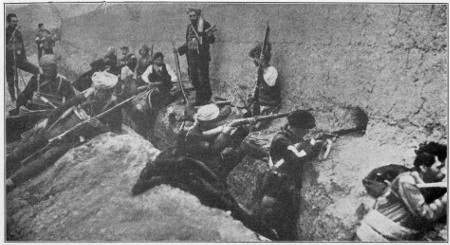
The bold retort of the Armenians to the Turkish proposal mentioned above, intensely angered the Turks, and from that very day the extermination of the Armenians was determined upon by the Turkish government. And in reality, arrests and persecutions within the Armenian vilayets began in the early part of September, 1914, a month and a half before the commencement of the Russo-Turkish war. The speed of the persecutions gained greater momentum as the months rolled by and tens of villages in different parts of Armenia were subjected to fire and sword. In the district of Van alone, during February and March of 1915, twenty-four villages were razed to their foundations and their populations put to the sword. Early in April of the same year, they attempted the massacre of the inhabitants of the city of Van as well, but the Armenians took up arms, and, guided by their brave leader, Aram, defended their lives and property for a whole month, until the Armenian volunteers from Erivan with Russian soldiers came to the rescue and saved them from the impending doom. This resistance on the part of the inhabitants of Van gave the Turkish government a pretext to deport in June and July of the same year the entire Armenian population of Turkish Armenia, with the pretended intention of transporting them to Mesopotamia, but with the actual determination to exterminate them. Out of the million and a half of Armenians deported, scarcely 400,000 to 500,000 reached the sandy deserts of Syria and Mesopotamia, and most of these were women, old men, and children, who were subjected in those desolate regions to the mortal pangs of famine. More than a million defenceless Armenians were murdered at the hands of Turkish soldiers and Turkish mobs. The gang of robbers, headed by Talaat and Enver, resorted to this fiendish means to eliminate the Armenian question once for all, because the Armenians had had the courage to oppose their Pan-Turanian policies. The barbarities of Jenghiz Khan and Tamerlane pale in comparison with the savageries which were perpetrated against the Turkish Armenians in the summer of 1915 during this wholesale massacre organized by the Turkish government. Mr. Morgenthau, who was the American ambassador at Constantinople during those frightful months, has proclaimed all these atrocities by his authentic pen to the civilized nations. This was the price which the Armenian people paid within the boundaries of Turkey for refusing to aid the Turco-German policies.
Now let us see what positive services from a military point of view this same martyred people rendered to the allied cause on both sides of the Turco-Russian boundary line.