Library · Why Armenia Should Be Free
Military Services Rendered by the Armenians on the Caucasian Front
In order to have an adequate comprehension of the events which took place on the Caucasian front, it would be well to bear in mind that all the peoples of Trans-Caucasia, including the Armenians, felt great enmity toward the government of the Czar, whose treatment of them in the past had been very tyrannical and very brutal. For this very reason, the Turco-German propaganda had easily won the sympathy of nearly 3,000,000 Tartars and 2,000,000 Georgians. The dream of the Tartars was to join the Ottoman Turks and re-establish the old great Tartar Empire, which was to extend from Constantinople to Samarkant, including all the lands of the Caucasus and Trans-Caspia, while the Georgians, through their alliance with the Turco-Germans, hoped to regain their lost independence in the western Caucasus. Only the 2,000,000 Armenians of the Caucasus were not influenced by the Turco-German propaganda, although they hated the Russian despotism as much as their neighbors. But, on the other hand, having very close acquaintance with the psychology of the Turkish race and with their ulterior aspirations, the Armenians had the political wisdom and courage to put aside their petty quarrels with Russian Czarism and throw in their lot with the allied cause.
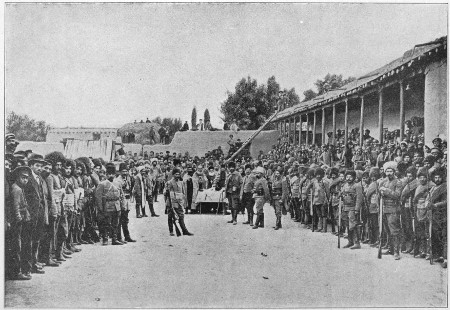
These were the circumstances under which the mobilization of 1914 took place in the Caucasus. The Armenian reservists, about 160,000 in number, gladly responded to the call, for the simple reason that they were to fight the arch enemy of their historic race. Besides the regular soldiers, nearly 20,000 volunteers expressed their readiness to take up arms against the Turks. The Georgians, on the other hand, answered the call very reluctantly, and the Armenian-Georgian relations were greatly strained from the very beginning. The attitude of the Armenians toward the despotic Russian government was incomprehensible to the Georgians, who thought that, because the Armenians sided with Russia,—the oppressor of all the Caucasian races,—they must be unfriendly to the Georgians. Many Georgian young men crossed the border from Batoum, went to Trebizond, and prepared bands of volunteers under the leadership of Prince Abashizé in order to aid the Turks. As to the Tartars, not being subject to call, they assumed the role of spectators on the one hand, and on the other used every means to arm themselves, impatiently awaiting the arrival of the Turks. The great land-owners of the provinces of Erivan, Elizavetpol, and Baku began to accumulate enormous stores, and prepare a huge reserve of sugar and wheat. The price of one rifle, which was 100 rubles ($50), rose to 1500 rubles ($750). Through Persia, the Germans took to the Caucasus great sums of money in order to push forward the task of arming the Tartars from the very first days of the war. Great numbers of young Tartars went to Persia and joined the Turkish armies. And all this was carried on in broad daylight under the very eyes of the short-sighted Russian bureaucracy.
The Russian administration of the Caucasus was more concerned with the Armenian “danger” and had no time to pay attention to the Georgians and the Tartars. Was it not a fact that officially no Georgian or Tartar question was placed on the diplomatic table, whereas the Armenian question was there? And for that very reason, before the commencement of the Russo-Turkish hostilities, the second and third army corps of the Caucasian army, the majority of which were Armenians, were transferred to the German front and were replaced by Russian army corps. Moreover, out of the 20,000 Armenian volunteers who responded to the call, only 7,000 were given arms; the authorities objected that they had no rifles ready, while a few months later the same administration distributed 24,000 rifles to the Kurds in Persia and in the district of Van. It is needless to say that all the Armenian officers and generals were transferred to the Western front; only one Armenian general was left as a specimen on the entire Caucasian front, General Nazarbekoff, and he was transferred to Persia, away from the Armenian border. Under these trying conditions commenced the Russo-Turkish war and the Armenian-Russian co-operation on the Caucasian front in the autumn of 1914. But, in spite of this suspicious and crafty attitude assumed by the Russian administration, the Armenian inhabitants of the Caucasus spared nothing in their power for the success of the Russian armies. In the three main unsuccessful Turkish offensives the battalions of Armenian volunteers played a great role. Let us now see just what took place during those offensives.
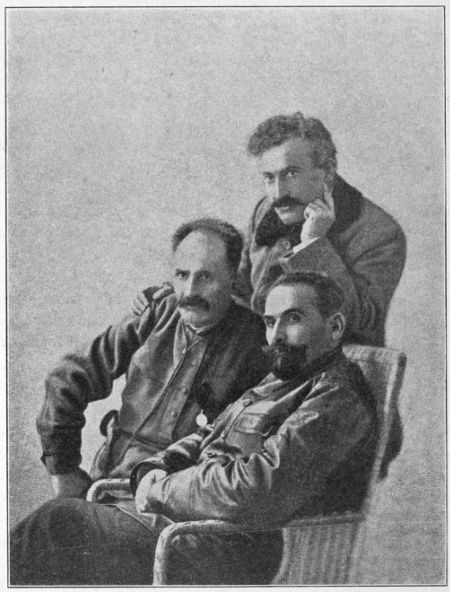
The first serious Turkish offensive took place in the beginning of December, 1914, when Enver Pasha attempted to reach Tiflis by shattering the right wing of the Russian army. The Turkish “Napoleon” was anxious to connect his name with that great victory which seemed certain to his puny brain. And with that very purpose in view he boarded Goeben, the German cruiser, and left Constantinople, amid great demonstrations. He reached Erzeroum in three days, thanks to the German automobiles which were ready for him at different stops between Trebizond and the frontier. The offensive was planned with great care, and had great chances of success if all the three wings of the Turkish army had reached their objectives on time. Enver had under his command three army corps—the ninth, the tenth, and the eleventh. The ninth army corps was to advance toward Ardahan by way of Olti and from there to march on Tiflis by way of Akhalkalag, when it should receive word that the tenth army corps had already captured Sarikamish and cut off the retreat of the Russian army of 60,000 men; while the eleventh army corps was to attack the centre of the Russian army near the frontier. The ninth army corps, in three days and without difficulty, reached Ardahan, where the local Moslem inhabitants assisted it in every possible way. The tenth army corps, during its march from Olti to Sarikamish, suffered a delay of twenty-four hours in the Barduz Pass, due to the heroic resistance of the fourth battalion of the Armenian volunteers which made up the Russian reserve. This delay of twenty-four hours enabled the Russians to concentrate a sufficient force around Sarikamish (which had been left entirely undefended) and thereby force back the ninth corps of the Turkish army. The Turks were so certain of the success of their plan that they had no transports with them and no extra supply of provisions. Opposite Sarikamish, where a battle was waged for three days and three nights, the Turks suffered a loss of 30,000 men, mostly due to cold rather than to the Russian arms. But if the Turkish army corps had reached Sarikamish twenty-four hours earlier, as was expected, it would have confronted only one battalion of Russian reserves, and that without artillery. This was the invaluable service rendered to the Russian army by the fourth battalion of the Armenian volunteers under the command of the matchless Keri. Six hundred Armenian veterans fell in the Barduz Pass, and at such a high price saved the 60,000 Russians from being taken prisoners by the Turks. This great service of the Armenians to the Russian army was announced at the time by Enver Pasha himself, when he returned to Constantinople immediately after his defeat. From that time on the government at Constantinople laid the blame of its defeat at the door of the Armenians, as a preliminary step in its preparation for the execution of its already-planned massacres of the Armenian people.
After their defeat at Sarikamish, the Turks attempted in April of 1915 to turn the extreme left wing of the Russian army by marching to Joulfa through Persia, and from there (in case of success) moving on to Baku, with the hope that the Tartar inhabitants of the eastern Caucasus would immediately join them and enable them to cut the only communicating line of railroad of the Russians, and thereby force the entire Russian army to retreat toward the northern Caucasus. The work of the intelligence department of the Turks was very well organized, especially as the Tartar and Georgian officers of the Caucasus rendered them invaluable services. The Turks knew very well that the Russians in Persia at that time had only one brigade of Russian troops under the command of the Armenian General Nazarbekoff and one battalion of Armenian volunteers scattered throughout Salmast and Urmia, while their own army was made up of one regular and well-drilled division of troops (sent especially from Constantinople) under the command of Khalil Bey and nearly 10,000 Kurds. Khalil Bey with his superior forces captured the city of Urmia in a few hours (taking prisoner nearly a thousand Russians) and victoriously marched on Salmast. Here took place one of the fiercest battles between the Armenians and the Turks. The first battalion of the Armenian volunteers, under the command of the veteran Andranik, strongly enforced in its trenches, repulsed the attacks of Khalil Bey for three days continuously, until the Russians, with the newly-arrived forces from the Caucasus, were able to put to flight the army of Khalil Bey. Thirty-six hundred Turkish soldiers lay dead before the Armenian trenches in the course of those three days.
In that very month of April, while Khalil Bey was confidently attempting, as we have seen, to surround the left wing of the Russian army in Persia, over in Van the Armenians had taken up arms in self-defence, and for one whole month were fighting another division of Turkish troops and thousands of Kurds until the first days of May, when three other battalions of Armenian volunteers, under the command of General Nikolaeff, came to the rescue, riding a distance of 250 kilometers (155 miles)—from Erivan to Van—in ten days. For one who is acquainted with the local conditions, it is an undisputed fact that if the Armenians of Van in April, 1915, by their heroic resistance had not kept busy that one division of regular Turkish troops and thousands of Kurds, and had made it possible for them to join the army of Khalil Bey, the Turks undoubtedly would have been able to crush the Russian forces in Persia and reach Baku in a few weeks, for the simple reason that from the banks of the Araxes to Baku the Russians had no forces at all, while the local Tartar inhabitants, armed and ready, were awaiting the coming of the Turks before rising en masse to join them. From the very [Pg 23]beginning of the war, Baku has been the real objective of the Turks, just as Paris has been the objective of the Germans, and that for two reasons: first, as a fountain of wealth, the Turks knew very well that the Russian government received from the oil wells of Baku an annual income of more than 200,000,000 rubles ($100,000,000), a sum which is more than all the revenues of the bankrupt Turkish government put together, and they looked upon these financial resources as indispensable for the accomplishment of their plan of a Pan-Turanian Empire; second, because the very plan of their Pan-Turanism had been introduced in Constantinople after 1908 by these very Tartars of Baku. The commanders of the Turkish forces engaged in Persia and Van—Khalil and Jevded—understood very well why their plans failed in the month of April, 1915; and that failure is the explanation of those frightful massacres which took place on the plains of Bitlis and Moush in June of the same year, when the armies of the same Khalil and Jevded, defeated in Persia and Van, were forced to retreat under the pressure of the Armenian volunteers.
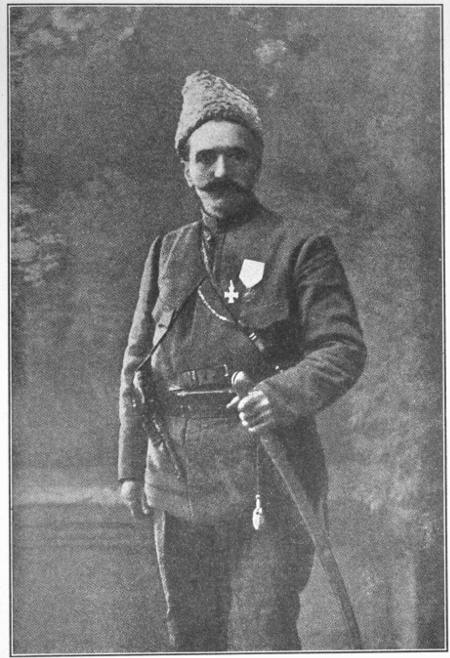
The third Turkish offensive took place early in July, 1915. This time the Turks, with all their available forces—eleven divisions of regular troops, again under the command of Khalil Bey—attacked the very center of the Caucasian army. In a few days they re-occupied Malashkert, Toutakh, and the greater part of the plains of Alashkert. During one week the center of the Russian army retreated more than 100 kilometers (62 miles) leaving behind the district of Van entirely unprotected, and in danger of being surrounded at any moment. If the Turks had had one or two more divisions of troops at their service in those days, they would have been able very easily to take prisoners the entire fourth army of the Russian left wing and cut off their way of retreat. In order to escape from this dangerous situation, the Russian left wing was forced to retreat hastily toward the Russian frontier and sent a part of its forces to aid the central army. Only at the end of July did the Russian army, having received aid from its left wing, and under the leadership of the Armenian General Nazarbekoff, succeed in forcing back the Turks to their former line. These were the conditions under which nearly 150,000 Armenian inhabitants of the district of Van were compelled to leave all their property at the mercy of the enemy’s fire and flee toward Erivan.