One-State Solution: Unite Armenia and Artsakh
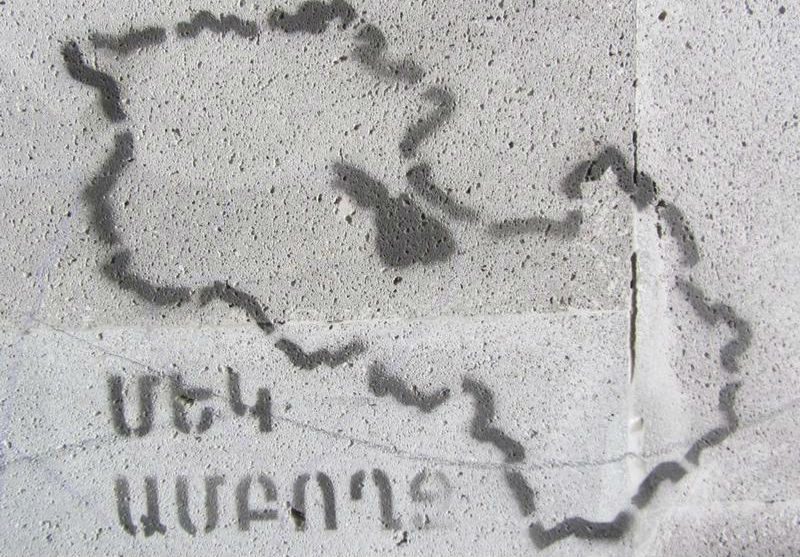
Aram Hovasapyan says Armenia and Artsakh should be united.
Every seasoned mountaineer, in his quest to conquer a chosen summit, stops from time to time to get his bearings, to reflect on how far he has come, to assess the trail ahead, and to map out any necessary changes in his path. This process is vital to the success of the mountaineer – the quality of execution distinguishing those who ultimately reach a challenging summit from those who do not. In Armenia’s own attempt to conquer the tall, formidable summit – that is, to resolve the issue of the mountainous enclave of Nagorno-Karabakh – we, as Armenians, are long overdue for a stop to reflect on where we have come, and where we are headed.
“The historic choice of the people of Artsakh is an irreversible reality now,” read a line of Armenia’s President Serzh Sargsyan’s message last year to the “dear people of Artsakh.” The laudatory address was delivered in commemoration of the 23rd anniversary of the declaration of independence of the Artsakh Republic, alternatively referred to as the Nagorno-Karabakh Republic. However, with the conflict between Armenia and Azerbaijan over the region unresolved, and the recent escalation of war rhetoric and skirmishes testing the fragile ceasefire agreement, one must ask: Was independence of the mountainous enclave the objective – and so-called “irreversible reality” – many of our parents fought to achieve?
The reality is that, 27 years after the start of the Karabakh movement, whose goal was the reunification of Armenia and Nagorno-Karabakh, we have strayed significantly off trail. What we have today is an Artsakh, for all intents and purposes an extension of the Republic of Armenia, an 11th province, that is entirely reliant on Armenia’s defense and funding. In the same respect, we also have an Artsakh that, since its original calls for reunion, has adopted multiple measures that, instead, push for independence. And finally, we have an Armenia that is caught in a state of limbo regarding its position on Nagorno-Karabakh. Armenia takes all measures to assure the survival and well-being of Artsakh’s residents, treating them as its own, but has, to this day, deferred from officially stating the relationship as it truly is.
The current state of affairs is not in the best interest of Armenians. Artsakh is – and must be – an integral part of Armenia and all actions undertaken must be toward cementing this irreversible reality.
A quick history refresher to better gauge the gravity of the dilemma at hand: The region consisting of the present-day Artsakh Republic has, for millennia, been under Armenian rule. For much of this history, the mountainous enclave was a province of Armenian kingdoms, and during foreign invasions, the Armenian princes of the region were able to maintain some autonomy. With the Soviet conquest of the Caucusus, the region seemed set to be placed under Armenian jurisdiction. In fact, on November 30, 1920, the Soviet government in Azerbaijan SSR recognized the region of Nagorno-Karabakh (as well as the regions of Nakhichevan and Zangezur) as a part of the newly proclaimed Armenian SSR. However, in a classic application of “divide and rule,” Soviet authorities in Moscow reversed previous decisions and allocated the 94-percent-Armenian-populated region to the Azerbaijani SSR.
For the next 60 some years, the irredentist feelings of the slighted Armenians were suppressed. However, with “glasnost” and “perestroika” taking hold during the final years of the Soviet Union, the call for righting a blatant wrong was rekindled. In February of 1988, exactly 27 years ago, Armenians in Yerevan and Stepanakert, the capitals of the Armenian SSR and the Nagorno-Karabakh Autonomous Oblast (NKAO) respectively, began marching under the slogan of “union” and clamors of “Karabakh is ours.” In the following months, the Supreme Soviets of the NKAO and the Armenian SSR voted and demanded for the unification of Nagorno-Karabakh with Soviet Armenia. With demands being rejected by the Azerbaijanis, and more importantly by the powers in Moscow, increased tensions in the region resulted in a full-scale war.
It’s important to note here that at no point in the initial stages of the Karabakh movement was independence for Nagorno-Karabakh even discussed. The region was viewed as an inseparable part of Armenia; union of historical Artsakh with Armenia was the natural call. Yet today, the Armenian government and most members of the Armenian Diaspora praise the independence of Artsakh as an historic feat.
Why the sharp turn in policy? Nagorno-Karabakh declared its independence in September of 1991 – a time when other Soviet republics, including Armenia and Azerbaijan, were declaring their own independence from the Soviet Union. A referendum for independence was conducted in December of 1991, when the Soviet Union was still internationally recognized, and the referendum was fully in accordance with the relevant Soviet law concerning exit from the USSR. The logic behind this policy and course of events is understandable; Nagorno-Karabakh was declaring independence from a failing Soviet Union in the same fashion as its neighboring countries were striving to create new democracies of their own. At the time, the decision to declare independence was viewed as a temporary, strategic solution, and reunification with Armenia would be the next step. The leaders of the Karabakh movement believed that a declaration of independence would resonate well on the international stage and dispel the false, but alarming, claims that the war in the Caucasus amounted to an attempted annexation of Nagorno-Karabakh by Armenia. What is less understandable is why, after the official fall of the Soviet Union, Nagorno-Karabakh didn’t reaffirm its original intention to create a union with Armenia. Instead, in 2006, a referendum was held that established a constitution and defined Nagorno-Karabakh as a sovereign state. However, to this day, no U.N. member state, including Armenia, recognizes Nagorno-Karabakh’s sovereign status.
How do we need to perceive the multiple declarations of Artsakh’s independence? Armenians sacrificed their lives, lost their sons and daughters, and endured a harsh blockade, all in the pursuit of a dream to restore, at least in part, a united, historical Armenia. Liberating our brethren in Nagorno-Karabakh and recovering the lands that were unjustifiably seized from us were the driving forces, the inspiration of all Armenians, in their sincere and unconditional support of Artsakh.
One can only hope there is a mutual understanding among the high-ranking officials of Armenia and Artsakh that the undeniable intention of both is to form a union. But there is room to speculate that the declarations of independence serve as a temporary disguise of true intentions, which will be revealed at a more opportune time. Serzh Sargsyan’s rebuttal of presidential candidate Raffi Hovannisian’s campaign promise that, as president, he will recognize the independence of Artsakh, supports this theory. Sargsyan questioned what improvement recognition of Nagorno-Karabakh’s independence will bring to Armenian citizens or to the population of Nagorno-Karabakh. He conceded, however, that if Azerbaijan launched military operations, “we will have nothing to lose at that time, and we will state that we are either a united state, or Karabakh is an independent state, and that we are the guarantor of the safety of the population of Karabakh.”
But the longer Armenia takes to declare its bona fide position, the more challenging it will be to elucidate and expound the quarter-of-a-century delay.
If it is fear that a declaration of union between Armenia and Artsakh will trigger a second war with Azerbaijan that prevents us from assuming an assertive stance, then we need not worry. The Azerbaijani government could have easily misrepresented any of the recent skirmishes as an act of aggression from Armenia – which is, in fact, what it did – and utilized its casualties as a pretext for war. The fact is that Azerbaijan is regularly testing Armenia’s military strength. The day that Azerbaijan assesses that it can attack and overpower Armenia’s defense is the day a war will begin.
If, on the other hand, Nagorno-Karabakh has the audacity to declare itself a tiny, less than 150,000-strong sovereign state with the intention to pursue independence yet rely on Armenia for all its needs, then Armenia must redress the situation. I won’t consider this alternative as a viable possibility, since Nagorno-Karabakh stands no chance of survival on its own in the demanding Caucasus Mountains.
Serzh Sargsyan’s congratulatory message quoted at the beginning sheds light at Armenia’s uncertain position regarding the status of Nagorno-Karabakh and this policy of indecision is producing detrimental repercussions. The president of Armenia commemorated the declaration of independence of Nagorno-Karabakh, but he addressed the “people of Artsakh,” not its citizens. It appears from this message that Armenia implicitly recognizes Nagorno-Karabakh’s independence from Azerbaijan but is not willing to recognize Nagorno-Karabakh as a sovereign nation, one capable of lawfully having citizens.
This ambiguity is also present in Armenia’s Ministry of Foreign Affairs website, where Armenia’s official position on the Nagorno-Karabakh conflict is laid out. There is no mention of a union with Nagorno-Karabakh nor is there any discussion of NKR’s self-declared independence. Instead, the only proclamation that exhibits conviction states that “Nagorno-Karabakh has no future as a part of Azerbaijan and whatever is the solution, it must emanate from the will of the Karabakh people.”
Conversely, on the official website of the president of the NKR, a section titled “The History of Formation” begins the narrative with Nagorno-Karabakh’s declaration of independence in September 1991. The page describes the NKR as a full-fledged parliamentary republic and there’s absolutely no reference to the critical Armenian involvement that allowed for the liberation of Nagorno-Karabakh from the Azerbaijani yoke.
Such vagueness and inconsistency in position has led to a hazardous situation, placing Armenia’s developments and investment in Artsakh over the last 27 years at risk.
Last October, Armenia finalized its accession into the Russian-led Eurasian Economic Union, but Nagorno-Karabakh was not allowed to enter. This raised grave security concerns and questioned the trade relationship between Armenia and Nagorno-Karabakh. When a reporter asked Nikolai Ryzhkov, co-chair of the Armenian-Russian Inter-Parliamentary Commission, why Russia was allowed to enter the EEU together with Crimea, but Armenia could not enter with Nagorno-Karabakh, Ryzhkov brazenly responded that Crimea had voted through a referendum to join Russia: “What were we supposed to do? Tell them, no, do not enter your native territory?”
The case for Artsakh being considered native Armenian territory is actually stronger than the case of Russia and Crimea. However, because we, as Armenians, cannot point to a referendum by Nagorno-Karabakh residents that resulted in a vote to form a union with Armenia, other nations can, and do, easily lever our handicap against us. We cannot afford to play the chess game of world politics without developing all our pieces; our opponents will take advantage of our weak strategy, and we risk losing the game.
The policy of influential lobby groups in the Armenian Diaspora, such as the Armenian National Committee of America (ANCA), is also distressing. Spurred and persuaded by Armenian lobbyists, the state legislatures of California, Maine and three other states have recognized the independence of Nagorno-Karabakh and have called for the US federal government to do the same. I already discussed the implausibility of independence for a region that has survived solely due to Armenia’s continuous support. It’s also of paramount importance to consider the international perception when the rest of the world sees Armenia and its Diaspora pursuing two differing courses on the same issue; namely, Armenia is plagued with indecision whether to recognize Artsakh’s independence or to form a union, while the Diaspora is actively pursuing recognition of Artsakh’s independence. Armenia and the Diaspora must, instead, present a united front and pursue world recognition of an Artsakh rightfully united with Armenia.
The current situation bears an eerie semblance to what transpired when Avetis Aharonian, the official representative of the First Republic of Armenia, and Boghos Nubar, the representative of the Ottoman Armenians, arrived at the Paris Peace Conference with differing petitions to the Council of Ten regarding the territories demanded from the Ottoman Empire. While Boghos Nubar demanded in his speech that Cilicia be included in the Ottoman lands allocated to the Armenians, the instructions Aharonian had received before leaving Yerevan were limited to demanding the six Armenian vilayets and an outlet to the Black Sea. Wanting to present a unified Armenian voice and, at the same time, adhere to his orders, Aharonian made only vague references to the territories of the former Ottoman Empire that the Armenians were demanding. “Both sections of Armenia represent a single geographic and economic whole,” he ambiguously stated, not clarifying exactly what lands the two sections consisted of. Consequently, Cilicia was not allotted to Armenia in the following Treaty of Sevres. Today, with Artsakh under Armenian control, Armenia and its Diaspora must bilaterally push for recognition of a united Armenia and Artsakh in order to avoid repeating a similar mistake.
In the wake of the centennial commemoration of the Armenian Genocide, when we are desperate and determined to obtain recognition of the tragedy, we are, at the same moment, disregarding, and even, ignoring, the perils facing our current state. Armenia’s population has dwindled. Young men abandon their motherland for fear of being recruited to the army and killed defending Artsakh’s border with Azerbaijan. Much of the remaining population is demoralized with the status-quo and seek more promising opportunities outside of Armenia. Risk-averse investors, who don’t like the current state of uncertainty regarding Armenia’s and Artsakh’s status, are investing their capital in more stable havens. Through all this, many Armenians focus their attention and efforts to recovering from Turkey the lands encompassing the six Armenian provinces of the former Ottoman Empire. Meanwhile, Artsakh, an integral part of historical Armenia, is currently under Armenian control, but we have not yet openly declared a union – and one that would rectify history’s injustices at that.
Armenia and Artsakh, unite!
A union between these two regions will uplift the spirit of its people and it will confirm that all progress and sacrifice was not made in vain. Armenian soldiers will know with certainty that they are fighting for a united Armenia and not for anything else. A union will pronounce Armenia’s true position in confidence and lead to a more stable policy going forward – one that is more conducive for growth and investment.
The elected officials and leaders of Armenia and Artsakh must come together and openly, without gimmicks, form a united coalition and create a document announcing their collective decision to unify Armenia and Artsakh. We must proclaim to the world that “United we stand!” The clock is ticking. We are in a state of urgency and we must act accordingly.
The views expressed by the author are his own and do not necessarily reflect the opinion of The Armenite.