Between Anticipation and Misery: The Syrian-Armenian Refugees of Lebanon
About 2.5 million civilians have fled Syria due to civil war. Tens of thousands of those civilians are Syrian-Armenian refugees who seek peace in Lebanon.
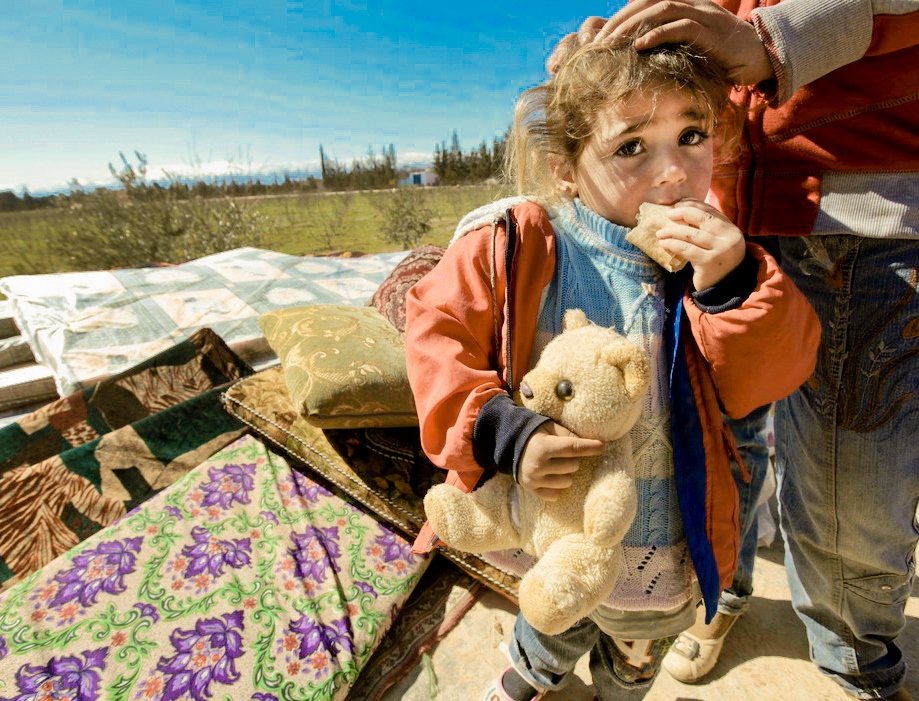
The Armenian Church celebrates the day of St. Gregory the Illuminator on the Sunday before Palm Sunday. On this day, the courtyard of the Holy See of Cilicia in Lebanon is filled with believers. This year, the occasion was twofold for the thousands of Aleppo-Armenian refugees in the country; Archbishop Shahan Sarkisian, the prelate of Aleppo, was to give the sermon that day. The crowd — filled with men and women, children and elderly — was eager to snap photographs with the Archbishop. They were creating souvenirs of a past that does not exist anymore. They knew they were not going to hear, at least not anytime soon, the Archbishop give a sermon in the Forty Martyrs Cathedral in Aleppo. The church, built by the Armenian community of Aleppo in the 15th century, was essentially abandoned.
The vast presence of Armenians in Aleppo began during the Armenian Kingdom of Cilicia, spanning from the 11th to the 14th century, when Armenian refugees fled the Seljuk Turkish invasion of Armenia. Yet the Armenian presence in this city turned indelible during the 17th century, when Armenians became silk traders between the Persian and Ottoman empires. As the trade routes passed through Aleppo, the community grew and became more complex. Along with it, the Forty Martyrs Cathedral transformed from a small chapel to a fully developed and ordained church.
It’s a misconception that Armenian communities of the Middle East were formed by the refugees of 1915. Although the Genocide shifted the epicenter of the nation from the Armenian Highlands toward the south, cities like Aleppo, Damascus, Jerusalem, Baghdad, Cairo, and even Beirut, are by no means new to Armenians. Books like Vardi Keshishian’s archive the many organizations and activities of Armenians in Aleppo long before 1915. The famous Hotel Baron, which is the oldest hotel in the region and opened in 1909, was built by two Armenian brothers, the Mazloumians, who also operated an underground network of rescuing refugees, orphans and even intellectuals and politicians.
A similar process also took place in Beirut, where local Armenians formed a committee of relief that eventually crystallized in the form of interconnected orphanages, giving birth to the modern Armenian community of Lebanon. Upon arrival, refugees were hosted by the respective local Armenian communities; But not all of Lebanon’s residents were welcoming. Newspapers were filled with pages of complaints by local Armenians about the newcomers in their neighborhoods. Yet, one way or another, with a bit of resistance and a bit of welcoming, with a bit of competition over limited resources and a bit of brotherly sharing, the old and new eventually merged.
The comparison of the refugee crisis in 1915 and the Syrian crisis of late might be lessening the former’s scope, but the experiences of Syrian-Armenian refugees today may give us some insight on what happened nearly 100 years ago during the Genocide. It also hits close to home in comparison to other occurrences of civil unrest in the Middle East.
Alber Kuyumjian, 26, is one of the estimated 10,000 Aleppo Armenians in Lebanon. He doesn’t hesitate to mention that his father hosted their Lebanese Armenian relatives for four years during the Lebanese Civil War, which lasted from 1975 to 1990. “We accepted the Lebanese [Armenians] because they were in hard conditions. We did not complain. Thank God we had money and we could afford accepting them,” Alber remembers. “Maybe they don’t have money now, but we are not asking much. We are being treated as foreigners,” he says, alluding to the difficulty Syrian-Armenians are having of being accepted by their Lebanese-Armenian brethren. Alber is currently living with his relatives in an apartment that resembles a refugee center more than a home.
Nerses Kuyumjian, 63, is Alber’s uncle and he’s the owner of the apartment-turned-refugee-camp. Nerses works as a taxi driver who commutes between Aleppo and Beirut, but he doesn’t yet know if he’ll be departing the following morning. He explains that everything depends on the news that comes from the borders, whether it be about road safety or the number of passengers who need a ride back to Beirut. Many refugees even come to his apartment to bring goods to be taken to Aleppo; others come to pick up things that were sent to them from their family still in the region. With all these ins and outs, it’s impossible to know who actually lives in the apartment, who’s a refugee staying for a short while, and who’s just visiting. Regardless, they all gather around the dining table together to eat, though some remain standing because there aren’t enough chairs for everyone.
But standing up while eating doesn’t seem to be the refugees’ biggest worry. One of the big issues of the Aleppo-Armenian refugees, both in Lebanon and Armenia, is education. After the influx to Armenia, Aleppo-Armenians established a daily school that was soon shut down due to lack of funding. In Beirut, there’s no need to establish a new school because the Syrian and Lebanese curriculums are more or less compatible, making it much easier to assimilate to the country’s education system.
Zarug Janian, 44, moved from Aleppo to Beirut in April 2013 so that her two children could still attend school in a safe environment. Her husband, however, still lives and works in Aleppo, a condition shared by many refugee families. Zarug pays the special discounted fee for Syrian refugees at the local Bourj Hammoud Armenian school but she says that “even the reduced fee is too much,” mentioning that she still has to pay for books, which, if converted to Syrian pounds, amounts to the entire salary of a full-time worker back in Aleppo.
It’s nearly impossible for a father to work in Aleppo and provide for his family in Beirut, so Zarug works too, with a salary that’s much less than a Lebanese national would work for. Lebanese employers aren’t against employing Syrians illegally, in many cases by even replacing their Lebanese employees with the less-demanding refugees. The result is a feeling of deep resentment toward Syrian refugees in Lebanon, both by Armenians and non-Armenians alike. In fact, the deepening economic crisis in the country is often blamed on the increasing number of refugees flooding in, with some estimates putting the refugee population in Lebanon at two million, which is roughly half of the population in the country.
Still, diaspora communities are liquid entities everywhere and the new eventually melts into the old, as it repeatedly has happened in these very same cities before. The refugees who find their way out of Lebanon go and “look for their luck on other shores,” as Ruben Hakhverdyan sings. Those who stay continue their life one way or another.
Back in Beirut, on St. Gregory the Illuminator’s day, loudspeakers broadcast Archbishop Sarkisian’s sermon to the masses in the courtyard: “We are out of hope, how can I give you hope? Yet we are in hope because we are here together, we are assembled here because we have hope, we are under this ceiling together, because we want to be together.” Amen.