Learning Armenian: Adventures of a Foreigner
The Armenian language is only spoken by six million people worldwide -- and a Singapore native is determined to be one of them.
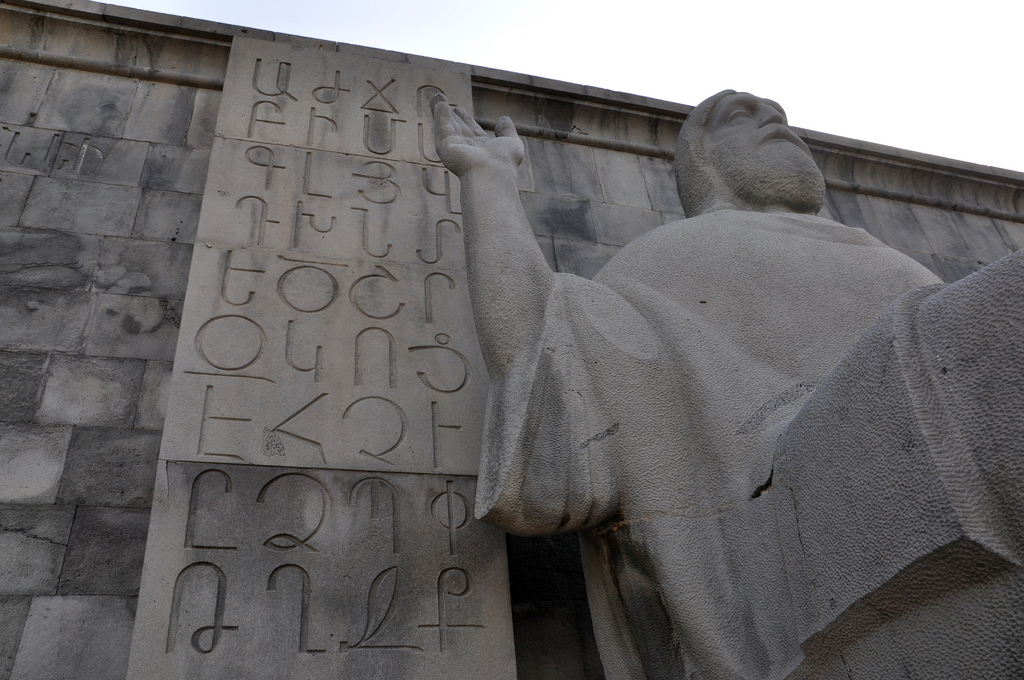
In her debut piece for The Armenite, Karmun Khoo has just signed up to learn the Armenian language. This is the story of her journey.
“I’m learning Armenian,” I tell my mother.
“Is that in India?” she asks.
I’m not surprised. Whenever I tell anyone I’m taking Armenian language courses online, they react with a mixture of puzzlement and interest.
“What for?” a friend once asked when she noticed me practicing cursive in the library. “Why would you do this to yourself?”
Because it’s a beautiful language, I wanted to tell her. Because it is lovely, and thousands of years old, and it will die if we do not keep it alive. But I felt I didn’t have the right to lecture her about Armenian culture. After all, I’m just a 16-year-old girl from Singapore living in Australia. Why would I need to learn Armenian, a language that’s only known by about six million people worldwide?
My friends are right. I must be crazy.
Still, I had already signed up for a spring term at the Armenian Virtual College, hosted by the Armenian General Benevolent Union (AGBU.) The process was easy enough: fill in a form, choose a few courses, and pay $199. The administrator I email for help tells me the money will be refunded if I get straight A’s. Cash back for good grades? I accept the challenge.
The instructors all have exotic last names like Khatchaturian and Petrosian. I wonder what my name would look like in Armenian, which, to me, resembles a sequence of scribbled glyphs. My course instructors waste no time contacting me. Bari galust, they say. Welcome. I have had experience with online courses before, having taught myself Catalan in the past, but my tutors have never been this welcoming.
“Armenians have a dark past,” Marina tells me. She is the course instructor for AL 102: “Beginner’s Eastern Armenian” and she will be guiding me through my entire AVC journey. I know what she is referring to – the 1915 Armenian Genocide, the Medz Yeghern, the Great Crime. It is this tragic event that led to the mass migration of a generation of Armenians, who brought their language with them to different countries and created countless diasporas around the world. It is this language, heavy with dark history, that I will now attempt to learn.
I also sign up for AH 222: “Armenian History Part One.” On another curious whim, I sign up for CP 422: “Basic Chess Strategy”; Armenians have always dominated the international chess scene and now I will find out why.
My fellow classmates have started to introduce themselves in the forums. There is an elderly schoolteacher from New York, a Syrian dentist surrounded by falling bombs, and a globetrotting debutante catching up on her mother’s native tongue between intercontinental flights. “I am Karmun, and I’m from Australia,” I write. “I hope that we will learn well together.” There are no replies.
In the downloadable folder that reads “Week 1,” I find some interactive lessons on the rudimentary alphabet. A recorded voice guides me through the entire set of lessons. I jot down notes in my notebook, making sure to acknowledge both the cursive and printed letters. “A” looks like a wobbly “w,” and arev is sun. The words are awkward in the ruled margins and my fingers cramp up when I trace their shapes over and over again.
“Don’t worry,” Marina reassures me. “There will be an assignment to practice what you have learned in Lesson 1.”
No amount of assignments will save my handwriting, I think. But I stay positive and transliterate the characters into my own phonetic system. “Farewell” sounds like cetaislusyun. It seems odd to learn such a heavy word as I’m just beginning, but Armenian is a language built on greetings — long goodbyes and warm hellos — and I feel powerless against the allure of each letter, forming a perfect shape alongside the next.
“I can’t wait for next week,” I type to Marina as I scan in my first assignment. “This is fun!”
“I am glad you think so,” she types back. “Next week we will have a virtual tour of the Armenian Genocide Memorial.”
Skype, I think. I wonder if I will be expected to speak Armenian during the tour. In any case, I flip open my notebook. I read the letters out loud and my mother tells me to stop chanting in Indian. I don’t bother to correct her. After all, Armenian may have started in a fertile valley between the Caucasus and the Euphrates, where the sun (arev, I remember) meets the water (jur), but now it is mine and I am determined to master it.